A new capability at DOBERMAN: bored piles up to 30 metres deep
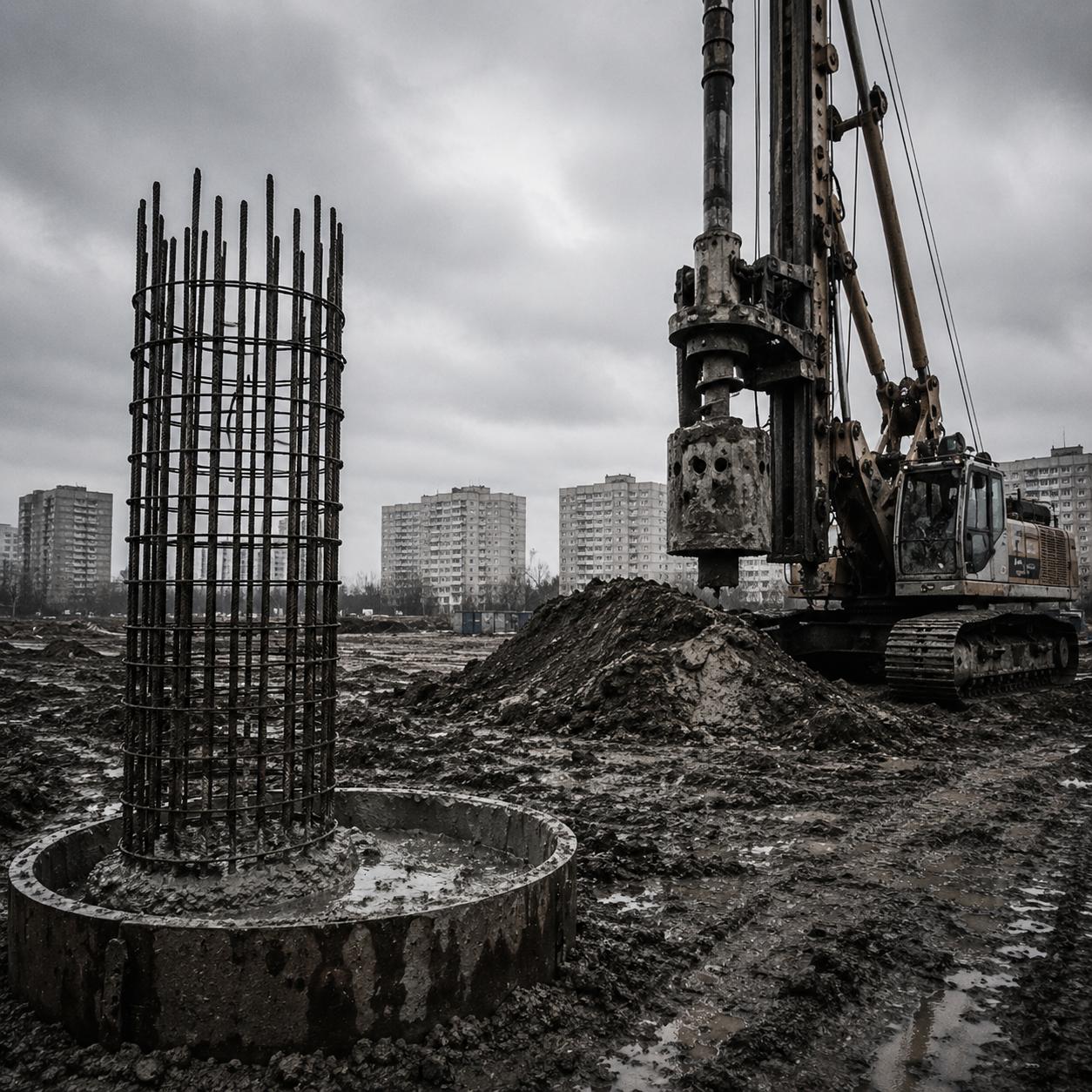
DOBERMAN has expanded the range of work the team carries out in-house. The company has added the installation of bored piles 600–1200 mm in diameter and up to 30 metres deep — from pre-design soil analysis through to the finished pile cap and the as-built documentation.
Why the company moved into piling
Most of the sites DOBERMAN works on in Kharkiv and the surrounding region sit in dense urban fabric and on difficult soils: sands, sandy loams, loams, clays, water-saturated layers. The immediate neighbours are residential buildings, hospitals, schools, operating production facilities — and often structures already weakened by shelling. A conventional driven pile is not an option here: every blow is transmitted to the adjacent foundations.
Previously the piled foundation on such sites had to be handed over to a subcontractor — and the substructure stage was most often the bottleneck in the schedule. Bringing piling in-house closes that gap: the foundation is now built by the same team that designs and constructs the building itself.
The technology
A bored pile is formed directly in the ground. First the borehole is drilled to the design level, then a reinforcement cage is lowered into it and the hole is filled with concrete. Vibration is minimal and the load-bearing capacity is high, so work can be carried out right up against buildings that remain in use.
The team has mastered both concreting methods. The dry method is used in stable soils with no water ingress. The wet method is used in water-saturated ground: the borehole walls are supported by a casing or by drilling fluid, and concreting is carried out through a tremie pipe, with the mix fed from the bottom upwards so that it displaces the water without segregating. The result is a dense pile shaft with no gaps or necking — that is, no hidden defects that only show up under load.
What the team now delivers itself
- pre-design analysis of soils and loads
- setting out and drilling of boreholes Ø 600–1200 mm
- fabrication and installation of reinforcement cages
- concreting of piles by the dry and wet (tremie) methods
- construction of pile fields and cast-in-situ pile caps
- quality control, pile load testing, as-built survey and documentation
Also part of the offering are bored injection piles (micropiles) and the strengthening of existing foundations, including alongside buildings still in use.
Part of a wider development
Piling continues the logic the company has followed in recent years: keeping the production chain in-house rather than stretching it across subcontractors. The same principle brought BIM design, laser scanning and digital construction control to DOBERMAN, along with the company's own mobile crane with a lifting capacity of up to 40 tonnes.
Because the company both designs and builds, the piled foundation is now laid out directly around the structural scheme of the building, the real loads and the routing of the utilities — rather than being fitted to a finished drawing after the fact. That removes both foundations over-engineered "with a margin" and underestimated loads.
The next step is to scale up pile fields for large reconstruction projects: residential buildings, industrial workshops, shelters and underground structures in Kharkiv and the region.